

.jpg)
The Edwin Smith Papyrus – The Beginning of Anatomical Medicine
1. Introduction
The Edwin Smith Papyrus is a medical text written in ancient Egyptian and is considered the oldest surviving surgical document in human history. Unlike mystical medical texts such as the Ebers Papyrus, the Edwin Smith Papyrus reflects a remarkably scientific and rational approach—offering detailed descriptions of body structures, injuries, symptoms, and treatments based on direct observation.
The text was copied around 1600 BC, but it may have originated from much older sources dating back to around 3000 BC. Today, the original manuscript is preserved at the Brooklyn Museum in the United States.
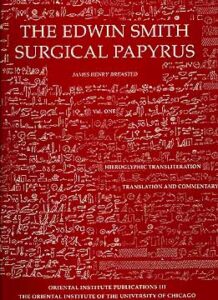
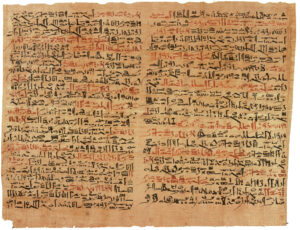
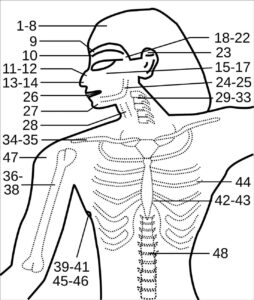
Những hình ảnh của The Edwin Smith Papyrus
2. History of Discovery and Preservation
This papyrus was purchased in 1862 in Luxor, Egypt, by Edwin Smith, an American scholar and antiquities dealer. After his death, the manuscript was donated by his daughter to the New-York Historical Society. In 1930, the Egyptologist James Henry Breasted of the University of Chicago translated and published the text, laying the foundation for modern research on the papyrus.
The papyrus is approximately 4.68 meters long and consists of 17 pages on the front and 5 pages on the back, recording 48 detailed clinical cases.
3. Structure and Main Content
The Edwin Smith Papyrus is regarded as a highly systematic work and the earliest known textbook of anatomy and surgery in human history. Each case usually includes a description of the injury, clinical observations, diagnosis, and treatment instructions.
Some notable examples include descriptions of skull fractures and hemiplegia, instructions for bandaging neck wounds, and recognition of spinal cord injury through loss of sensation and paralysis of the lower limbs. Remarkably, the text contains almost no elements of superstition, reflecting a medical way of thinking grounded in logic and experience.
4. Scientific Value and Historical Significance
The Edwin Smith Papyrus is strong evidence of the early development of empirical medicine. It shows that the ancient Egyptians possessed astonishing knowledge of neuroanatomy, the skull, the brain, and the spinal cord. It marks a transition from religious medicine to evidence-based medicine—the foundation of modern medical science.
Historian James Henry Breasted once remarked:
“If Hippocrates is regarded as the father of Western medicine, then the Edwin Smith Papyrus shows that the Egyptians preceded him by more than a millennium.”
5. Influence on Modern Medicine
Today, the Edwin Smith Papyrus is seen as a foundation of modern clinical reasoning—observing, recording, analyzing, and treating based on evidence. Many concepts found in the text, such as cranial trauma, spinal paralysis, and open wounds, have become standard medical terminology.
In medical education, studying the Edwin Smith Papyrus helps students understand the origins of medical thought and the evolution of the healing profession over thousands of years.
6. Conclusion
The Edwin Smith Papyrus is a symbol of the intelligence and scientific spirit of ancient Egyptian civilization. With its empirical method of description, this text laid the groundwork for anatomy, surgery, and neurology—a testament to humanity’s first steps in exploring the human body.


Other Posts